The CBSE Grade 9 Social Science syllabus 2026-27 has been significantly revised in alignment with the National Education Policy (NEP) 2020 and the National Curriculum Framework (NCF) 2023. The new syllabus focuses on conceptual understanding, critical thinking, real-life applications, and interdisciplinary learning rather than rote memorisation.
This detailed guide will help you understand the latest CBSE Grade 9 Social Science syllabus, chapter-wise topics, assessment pattern, and preparation tips.
What’s New in CBSE Grade 9 Social Science Syllabus 2026-27?
The revised Social Science curriculum introduces several contemporary, practical topics that help students connect classroom learning to real-world issues. The syllabus now emphasises:
- Critical thinking and analytical skills
- Environmental awareness and climate change
- Financial literacy and entrepreneurship
- Democratic values and citizenship
- India’s cultural and historical heritage
- Real-life application of social science concepts
The curriculum has been redesigned to make learning more engaging and meaningful.
CBSE Class 9 Social Science Syllabus 2026-27
The Cbse Grade 9 Social Science Syllabus 2026-27syllabus is divided into Part 1 and Part 2, covering Geography, History, Political Science, and Economics in an integrated format.
PART 1
Chapter 1: Understanding Social Science
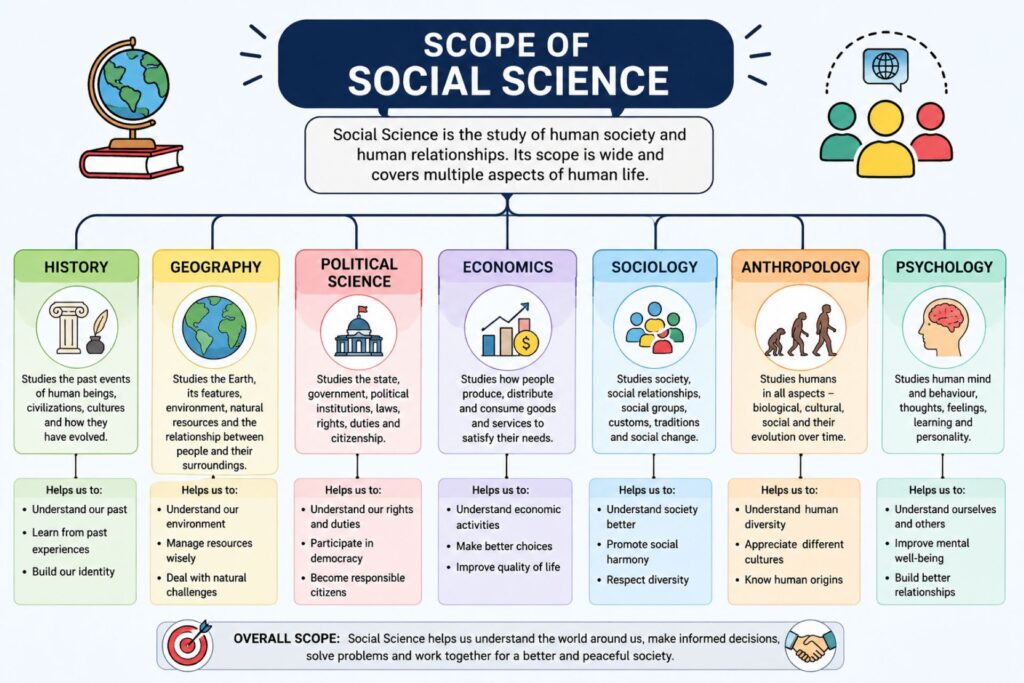
- Meaning and scope of Social Science
- Importance of Social Science
- Indian perspective of Social Science
Chapter 2: Shaping of the Earth’s Surface
- Plate Tectonics
- Interior of the Earth
- Weathering and Erosion
- Landforms and Natural Disasters
- Earthquakes, Landslides, GLOF, Dust Storms
Chapter 3: Atmosphere and Climate
- Structure of the Atmosphere
- Weather and Climate
- Indian Monsoon
- Climate Change
- Carbon Footprint
Chapter 4: Early Humans and the Beginning of Civilisation
- Human Evolution
- Stone Age Cultures
- Neolithic Revolution
- Harappan Civilization
- Mesopotamian, Egyptian, and Chinese Civilisations
Chapter 5: State and Society
- Vedic Age
- Political Institutions
- Educational Heritage
- Trade and Commerce
- Crafts and Industries
Chapter 6: Democracy
- Meaning and Features of Democracy
- Roots of Democracy in India
- Challenges to Democracy
- Democratic Systems Around the World

Chapter 7: Elections
- Importance of Elections
- Electoral Systems
- Election Commission of India
- Electoral Rolls
- Political Parties
Chapter 8: Building Blocks in Economics
- Scarcity and Choice
- Opportunity Cost
- Economic Systems
- Welfare Economy
Chapter 9: The Price Puzzle – What Drives the Market?
- Demand and Supply
- Price Determination
- Market Failures
- Public Goods
- Information Asymmetry
Download the New NCERT-Aligned Book
Gateway to Social Science Class 9 (Part 1) — First Edition, February 2026. Aligned with the latest NCERT Syllabus, NEP 2020 & NCF 2023. Get the complete PDF with all 12 chapters.
PART 2
Chapter 1: Oceans and Life
- Ocean Relief
- Tides and Ocean Currents
- Marine Resources
- Fishing and Livelihoods
- Cyclones and Tsunamis
- Maritime Rules
Chapter 2: Life on Earth
- Biomes
- Biosphere Reserves
- Forest Conservation
- Wildlife Protection
- Forest Dwellers and Livelihoods
Chapter 3: Resistance and Resilience (1000 CE – 1700 CE)
- Protection of Sovereignty
- Alliances and Confederacies
- Art and Architecture
- Bhakti Tradition
- Forts and Fortifications
Chapter 4: India and the World – I (1900 BCE – 1200 CE)
- Trade with Ancient Civilisations
- Cultural Exchanges
- Indian Knowledge Systems
- Mathematics, Astronomy, and Medicine
Chapter 5: Authority
- Concepts of Authority
- Ancient Indian Political Thought
- Justice and Security
- Role of Citizens
- Democratic Institutions
Chapter 6: From Ideas to Startups
- Entrepreneurship
- Startup Ecosystem in India
- MSMEs
- Make in India
- Business Planning
- Basic Accounting Concepts
Chapter 7: Smart Ways to Manage Your Finances
- Personal Financial Management
- Inflation
- Budgeting
- Savings and Investments
- Insurance
- Income Tax Basics
Assessment Pattern
CBSE follows a balanced assessment system comprising:
| Component | Marks |
|---|---|
| Annual Examination | 80 |
| Internal Assessment | 20 |
| Total | 100 |
Internal Assessment includes:
- Periodic Tests
- Multiple Assessments
- Project Work
- Portfolio
Important Changes in the New CBSE Grade 9 Social Science Syllabus 2026-27
1. Financial Literacy Introduced
Students will learn budgeting, investments, insurance, taxation, and financial planning.
2. Entrepreneurship Added
The chapter “From Ideas to Startups” introduces business concepts at an early stage.
3. Greater Focus on Climate Change
Environmental issues, sustainability, and carbon footprints are now important topics.
4. Integrated Learning Approach
History, Geography, Political Science, and Economics are interconnected to improve understanding.
5. Skill-Based Learning
The syllabus promotes application-based and competency-focused learning instead of memorisation.
Preparation Tips for Students
Read NCERT Thoroughly
NCERT textbooks remain the most important resource for CBSE examinations.
Make Short Notes
Prepare chapter-wise summaries, mind maps, and flashcards.
Focus on Concepts
Understand the “why” behind every topic instead of learning answers by heart.
Practice Map Work
Geography and History-related map questions can help improve scores.
Stay Updated with Current Affairs
Topics like climate change, democracy, elections, and economics become easier when connected to real-world events.
Read More: NCERT Solution For Class 9 Political Science Chapter 2 Constitutional Design
Conclusion
The CBSE Grade 9 Social Science Syllabus 2026-27 represents a major shift toward practical, skill-based, and future-ready education. With topics ranging from climate change and democracy to entrepreneurship and personal finance, the new curriculum prepares students not only for examinations but also for responsible citizenship and real-life decision-making.
Students should focus on understanding concepts, practising regularly, and using NCERT textbooks as their primary study resource. With proper planning and consistent effort, scoring well in Social Science becomes much easier.